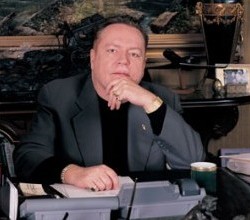
Larry Flynt

Archive for July, 2012

Coming: The Total Surveillance State?

Monday, July 30th, 2012

AIRCRAFT WITHOUT PILOTS, PASSENGERS OR BEVERAGE CARTS—JUST CAMERAS AIMED AT YOU—MAY SOON FILL THE SKY

by Nat Hentoff

George W. Bush, Dick Cheney and Barack Obama have convinced some Americans that no matter how or where they express themselves, their thoughts may wind up in a Big Brother database. But most of us are more preoccupied with immediate, all-too-real fears like higher gasoline prices and unemployment.

In his article “Dawn of the Drone: The Realization of the Total Surveillance State,” the Rutherford Institute’s John Whitehead offers a scarier scenario: implementation of the Federal Aviation Administration (FAA) Reauthorization Act. In a few years, this legislation may prompt a lot of us to look skyward with chilling apprehension.

“Imagine a robot hovering overhead as you go about your day, driving to and from your work,” Whitehead envisions. “The robot records your every movement with a surveillance camera and streams the information to a government command center. … If you make a wrong move or even appear to be doing something suspicious, the police will respond quickly.”

You see, the FAA Reauthorization Act mandates that there will be about 30,000 pilotless aircraft in our skies by 2020. As I’ve reported, these ghostlike carriers of surveillance cameras have already been sent out by the Department of Homeland Security and local and state police to observe “suspicious” activists’ meetings or to follow likely narcotics distributors.

The ACLU insists that “drones not be deployed indiscriminately unless there are grounds to believe the unmanned aerial planes will collect evidence about a specific crime.” Voicing optimism, the ACLU also acknowledges, “If we can set some good privacy ground rules, our society can enjoy the benefits of this technology without having to worry about its darker potentials.”

We’ll all be protected under the supposedly transparent Obama Administration? And in view of the millions of dollars to be harvested by the aviation industry thanks to law enforcement’s delight in the drone, would a Republican administration be any more of a threat to the rapidly fading Fourth Amendment than Obama and our current Congressional leaders?

Regarding drones, John Whitehead is a deeply experienced realist: “Until the American people succeed in raising their collective voices against this technological tyranny, the powers that be will continue on the path of total control, and the condition of our civil liberties will become more dire with every passing day.”

So will this really be “the realization of the total surveillance state”? Don’t count on it. I have never forgotten the dissenting opinion of Justice Louis Brandeis in the U.S. Supreme Court’s first wiretapping case, Olmstead v. United States (1928). Recognizing that the creation of inventive technologies would be boundless, he wrote: “Ways may someday be developed by which the government, without removing papers from secret drawers, can reproduce them in court, and by which it will be enabled to expose to a jury the most intimate occurrences of the home.”

In Constitution 3.0: Freedom and Technological Change, Jeffrey Rosen—whose byline on these dread matters I never miss—wrote: “The technologies that Brandeis imagined have now come to pass—and they do not only affect privacy; they affect a broad range of Constitutional values.”

Here is how the ACLU is trying to protect you: “Now we have joined together with our coalition partner, the Electronic Privacy Information Center, to petition the FAA to ‘address the threat to privacy and civil liberties involved in the integration of drones in the national airspace.’” Remember: Some drones may soon have facialrecognition capability.

“You should sign too,” the ACLU continues. “Let’s make it clear that Americans are deeply concerned that drones not become a common feature of our skies until strong privacy protections are in place to ensure they do not become tools for routine aerial surveillance of American life.”

Are we “deeply concerned”? Then how come we don’t make that clear? For instance, do you know or care that the FBI publishes characteristics of people we should report as possible terrorists? As U.S. Senator Rand Paul (R-Kentucky) notes in his National Review Online article “Indefinite Detention and American Citizens,” the list includes “the possession of ‘meals ready-toeat,’ missing fingers, brightly colored stains on clothing, paying for products in cash and changes in hair color.”

Like his father, Representative Ron Paul (R-Texas), Rand Paul is one of the few members of Congress who truly cares about Americans’ right to privacy. So when you see a drone up in the sky, try to look as if you’re not a national security risk.

————————————-

Nat Hentoff is a historian of the Constitution, a jazz critic and a columnist for the Village Voice and Free Inquiry. His incisive books include The First Freedom: The Tumultuous History of Free Speech in America and Living the Bill of Rights.


Richard Heinberg: Salvaging the American Dream

Monday, July 23rd, 2012

A FRONTLINE ACTIVIST AND AUTHOR EXPLAINS WHY WE’RE NOW PAYING THE PRICE FOR AN OVERRELIANCE ON FOSSIL FUELS AND EASILY OBTAINABLE CREDIT—BUT THERE IS HOPE FOR THE FUTURE.

Richard Heinberg Interviewed by Mark Johnson

Gasoline prices are spiraling, nations are fighting over oil, economies are collapsing and protesters are taking to the street in cities around the world. Coincidence? Not on your life.

In his new book The End of Growth: Adapting to Our New Economic Reality, Richard Heinberg connects the dots, revealing what the smart money already knows: You can’t have unlimited growth without cheap energy and easy credit. And both of those are drying up. Prepare to live differently.

Heinberg—an energy expert and educator who has written ten books—leads an ongoing campaign to transition the U.S. economy away from fossil fuels. He is also Senior Fellow-in-Residence at the Post Carbon Institute, a nonprofit organization dedicated to building sustainable communities.

HUSTLER: Is the current economic recovery real?

RICHARD HEINBERG: We have managed to produce a technical recovery over the past couple of years through enormous amounts of government intervention. We’ve bought ourselves some time, but it came with a big price tag—several trillion dollars if you total it all up in stimulus spending and bailouts for the banks.

The problem is it’s all temporary. It wasn’t an ordinary recession, and this isn’t a standard recovery.We’re not shifting back into a normal growth mode where we can expect declining unemployment, increased productivity, higher profits and increased return on investments. We are in the early stages of a much longer-term economic shift that is going to look like the Great Depression, only worse and longer-lasting.

Twenty-twelve could be a key year. In 2008, the mother of all debt bubbles burst. That crisis was papered over with bailouts that enabled the banks to hide trillions in toxic assets. It’s only a matter of time before those toxic assets get to market. When that happens, much of the financial industry will be revealed to be insolvent.

The Europeans are also going to extraordinary lengths to contain their debt crisis, but there’s not much they can do. When the European bubble bursts, it’s going to infect us. U.S. banks own European bonds and have interlocking investments with European banks. There’s no way you can keep that sort of thing contained.

The global economy is imploding, and we’re running out of oil at the same time. What’s the connection?

Cheap energy fed economic growth during the 20th century, and the era of cheap energy is coming to an end. There are all kinds of unconventional fossil fuels out there being touted as the next great energy source, but all of them are very lowgrade substitutes. They have a much lower energy return on the energy we invest getting them out of the ground and processing them.

The entire economy depends on energy. If oil becomes too expensive or the oil flow is shut off, the economy goes into a tailspin. We’ve seen this repeatedly over the past several decades. In 2008, we saw the oil price spike up to almost $150 a barrel, and almost immediately the global economy crashed. The housing bubble burst at the same time. Where did it start? In suburban areas where people were spending a large portion of their paycheck to fill up the tank in their SUV.

By September 2008, we were seeing the collapse of Lehman Bros. and the near-collapse of the entire Wall Street banking industry. As energy gets costlier and more scarce, the entire economy has to contract and adapt in response. Wall Street has its way of making the problem worse by spinning out debt on the basis of expectation of future profits. Even if we didn’t have the problem of peak oil, we would be facing a financial crisis as a result of overreliance on debt and unrealistic growth. But combine those two things—limits to cheap energy and limits to debt—and you have a historic challenge to civilization itself. We’re looking at a whole generation of social, economic and political chaos.

Go ahead and lay the blame. Whose fault is it?

It’s everybody’s fault in that we all got hooked on economic growth and cheap energy. We’ve all participated in the consumer bonanza. But some of us have profited from this situation more than others.

The government commission that was appointed to analyze the financial crash of 2008 came to the conclusion that there was criminal behavior on the part of executives at several institutions, including Goldman Sachs. So far no one has been prosecuted. Clearly that is a political failure. People should be in prison as a result of what was done.

Every politician wants to promise more economic growth. Can you imagine being a politician—either Democrat or Republican— and having to stand up before your constituents and say, “Well, this is it folks. We’re going to have to tighten our belts and do with less because we’ve reached the end of economic growth”? The electorate is going to vote for someone who promises more, cheaper and faster even if it can’t be delivered. All these bailouts are aimed at salvaging economic growth.

Is it a losing game?

It’s inevitable that we will get rid of the growth ideology, not because we suddenly all wise up, but just because it becomes impossible to maintain growth. The growth we’re hooked on is not something that’s been going on for centuries or millennia. It’s only been happening for a few decades. The normal condition is very slow growth, stasis or occasional contraction.

We’ve gotten to a point in history where economic growth as we’ve known it is probably finished. We should have known this point would arrive because you can’t grow anything forever on a finite planet. In fact, we were warned back in the early 1970s by a best-selling report called The Limits to Growth, which told us that growth would come to an end sometime in the early part of the 21st century.

After that report, it ought to have been clear to policymakers that nations should be making plans for an eventual end to economic growth. But as far as I can tell, no such Plan B exists. That is a catastrophic failure on the part of our political system. Since about 1980, most of America’s economic growth has been based on increasing debt. Debt has grown faster than gross domestic product in almost every year. Now we’ve reached the limits to what we can do not only with cheap energy but also with debt. At this point the only thing we can do is hunker down, get back to basics and learn how to live in an economy that’s not growing.

What does that mean on the individual level?

The first thing to do is get out of debt. Debt becomes more and more of a trap in this kind of a situation. If you’re going into debt, you’re assuming your economic circumstances are going to be better a few years down the line. That’s an unrealistic assumption at this point in time for almost anyone to make. This is a good time to be paying off debts, reducing consumption and learning how to be more self-sufficient.

Advertising has deliberately stoked human wants and desires in order to create opportunity for economic growth. We have to find ways of satisfying our innate desire for novelty that don’t express themselves through taking the credit card to the mall and maxing it out. Learning to satisfy those urges by doing things that actually improve our survival prospects. Learning how to grow food and preserve food, getting chickens for the backyard and learning how to take care of them are activities that are actually very pleasurable and can be quite absorbing. But they actually improve our survival prospects rather than diminish them, which is what happens when we go shopping.

The challenge that’s facing us is one that is best faced in a cooperative and collective way. The tendency is to go out and become a survivalist and stockpile ammunition and gold, but I don’t think that’s going to get anyone very far under the conditions that are developing. The best we can do is try to work together within our communities to build trust because trust is going to be our most important currency. That will mean sharing more, volunteering more, figuring out what are the needs within our communities and how we can work together to fill those needs. These are the kinds of things that people do in hard times. If you look back at how people survived the Great Depression, for example, they did exactly these kinds of things. It’s human instinct to pull back and regroup.

What would a post-growth economy look like?

It looks a lot like an ecosystem. In an ecosystem, the total amount of energy and materials flowing through is pretty much the same from year to year, and yet an ecosystem is a dynamic thing. Some species are expanding in numbers, others are declining, and there’s general competition for the available energy and nutrients.

A post-growth economy is going to be dynamic. What makes it different from our current economy is that there will be no realistic expectation of living off of returns on investments. In a growing economy, credit and debt become central features, and a large class of people is able to live off investments and unearned income. In a nongrowing economy, everybody’s going to have to pull his own weight.

Corporations were a signal feature of the growth era of economic history. I’m not sure that they’re very well adapted to the post-growth era. I foresee cooperatives and guilds and individual producers competing and cooperating in various ways to make the economy go. A nongrowing economy looks and feels much healthier because everyone is playing by the same rules.

What are the first things you would do to fix the current economic system?

The first would be to get rid of gross domestic product as a measure and target for economic performance. We have to begin to see quality of life as our main goal. The second would be to provide the basics for everyone. I’m talking about food, shelter, basic medical care, education, family planning. Having access to those basics will give us a platform of social stability to enable us to deal with the whole range of challenges coming at us.

A lot of people will read this and think, This guy is a socialist.

Socialism was a utopian program. I’m talking about the needed immediate response to an almost-wartime situation. In times of war, governments resort to extraordinary economic measures—like rationing fuel and food—to make sure that there’s a platform of social stability to support the extraordinary effort that the entire society is undertaking.

We have to seriously begin to deal with the limits of the natural world: limited oil, topsoil and fresh water. We have to undertake a fundamental reorganization of our economy and patterns of consumption so that we live within those limits. That means reforming our transport system, our food system and just about everything else.

It may be possible to persuade at least local policymakers that these kinds of efforts are in everyone’s best interests, but it is going to be a battle for economic space. I think those of us who understand what’s at stake are going to have to roll up our shirtsleeves and get into that fight. I don’t see any other way around it.

Is the Occupy movement a step in the right direction?

One of my concerns with the Occupy movement has been that it is almost inevitably focused around questions of distribution of wealth. That’s perfectly legitimate, but that’s not the essence of the crisis that we’re facing. We’re facing the end of an entire economic paradigm, and coming to terms with that is really going to require a change—not just in Washington, D.C., but in every household around the country.

I think we’ve only seen the beginning of the Occupy movement. I would call it a global end-ofgrowth uprising because the Occupy movement is just our domestic version of what’s been going on in many countries around the world.

We’ve created a situation of structural corruption. We’ve removed all sorts of financial regulations. We’ve made it easier for corporations to contribute to political campaigns, and the result is now all three branches of government are complicit in this structural corruption, so there’s no way to alter that situation from within the system. You can’t just vote for the other political party because, in fact, both [major] political parties are now owned by Wall Street. The only way out is a general mass protest, such as the Occupy movement.

As long as economies are growing, people are willing to put up with a lot of political corruption and dysfunction. But once the economy stops growing and people are hurting in their daily lives, they’re willing to put up with a lot less. So if our economy is about to go back into crisis mode, we’re likely to see much more in the way of social unrest. More people will be in the streets with stronger demands. Just as the protesters in other countries have overthrown governments, the same thing will happen in this country.

Governments can only maintain power with the consent of the people. Once that consent is withdrawn, all bets are off.

——————————————

For more information, go to PostCarbon.org and EnergyBulletin.net. The End of Growth can be purchased at RichardHeinberg.com.


Can The Constitution Survive Obama’s Reelection?

Monday, July 16th, 2012

THE NATIONAL DEFENSE AUTHORIZATION ACT FURTHER SOURS THE SWEET LAND OF LIBERTY

by Nat Hentoff

When the Tea Partiers broke into the national consciousness, with copies of the Constitution in their pockets as they rallied, I was too quickly impressed. I titled one of my syndicated columns “The New American Revolution.” But in the months since President Barack Obama signed a law passed by a bipartisan Congress that smashes key parts of the Bill of Rights, the Tea Partiers have not risen to defend those most basic personal liberties. Nor have Republicans, except for a few, been publicly criticizing the National Defense Authorization Act (NDAA). The Democrats, of course, are nearly unanimous in support of their hollow leader.

On that fateful day—December 31, 2011— ACLU Executive Director Anthony Romero declared that Obama “will forever be known as the President who signed indefinite detention, without charge or trial, into law. The statute is particularly dangerous because it has no temporal or geographic limitations, and can be used by this and future Presidents to militarily detain people captured far from any battlefield.” This includes American citizens caged (a more accurate term than detained ) right here in this country.

In his signing statement, Obama tried to pretend that by interpreting the law in his own regal way, American citizens won’t be subject to detention by the military. He’s the boss!

But, Mr. President, even you cannot “interpret” what is plainly in the NDAA. Enter former federal judges Abner Mikva, William Sessions and John Gibbons, who are cited in an Antiwar.com article by Carl Mirra.They warn that the law “codifies methods such as indefinite detention without charge and mandatory military detention and make[s] them applicable to virtually anyone…including U.S. citizens.”

And dig this from the same story: Senator Lindsey Graham (R-South Carolina) “is one of the few supporters of the NDAA to plainly admit that ‘the statement of authority to detain does apply to American citizens, and it designates the world as the battlefield, including the homeland.’” Whose homeland?

That American citizens can and will be subject to military imprisonment subverts the Fifth Amendment’s guarantee that “no person shall be compelled in any criminal case to be… deprived of life, liberty or property, without due process of law.” Yet Senator Carl Levin (D-Michigan) maintains that a law existing before Obama signed the NDAA has been held by the U.S. Supreme Court as having no bar “to indefinite detention of American citizens.” But the High Court also gave habeas corpus rights to such prisoners. And it has yet to rule on a law that radically nullified the Fifth Amendment’s very core of the American system of justice.

There’s more to this astonishing transmogrification of what all Presidents embrace as “our values.” Remember the controversy surrounding previous administrations’ renditions? The CIA would kidnap suspected terrorists, then send them to foreign nations known for torturing their captives during “enhanced interrogations.”

As pointed out by Harvey Wasserman and Bob Fitrakis in the article “2012’s Civil Liberties Apocalypse Has Already Happened,” the NDAA “allows trial by military tribunal, or ‘transfer to the custody or control of the person’s country of origin’ or transfer to ‘any other foreign country or any other foreign entity.’” Any other country? Huh? Somalia? North Korea? Afghanistan?

To what extent will Obama’s signature on this utter contempt for the Bill of Rights affect the President’s reelection campaign? This could depend on how many American voters are familiar with the Bill of Rights. And even if they are, how many have paid attention to the National Defense Authorization Act? Jonathan Turley—one of this country’s most knowledgeable civil liberties lawyers and law professors— notes: “The almost complete failure of the mainstream media to cover this issue is shocking. Many reporters have bought into the spin of the Obama Administration as they did the spin over torture by the Bush Administration.”

Affirming my belief that the Constitution has virtually become wastepaper, Wasserman and Fitrakis have come to this doomsday conclusion: “What most of the nation doesn’t realize is that the end of our basic civil liberties, in place since the December 1791 ratification of the Bill of Rights, has already taken place.”

If Obama manages to occupy the White House for another four years, America will continue turning into a country the Founding Fathers would deplore. Not that I have faith in a Republican coming to the rescue.

————————–

Nat Hentoff is a historian of the Constitution, a jazz critic and a columnist for the Village Voice and Free Inquiry. His incisive books include The First Freedom: The Tumultuous History of Free Speech in America; Living the Bill of Rights ; and the forthcoming Is This Still America?


Mitt Romney: Greed-Run-Wild Apostle

Monday, July 9th, 2012

At first I thought, Why not a Mormon for President? I know it’s a weird religion, what with those kinky undergarments they wear and the bizarre mumbo jumbo about some guy who claimed he found divine wisdom on some tablets given to him by an angel and then came on like he was the next Moses.

But what’s the big deal? If you’ve ever looked closely at those other, more mainstream religions our past Presidents claimed to believe in, they’re equally absurd. That’s the whole point of religion: invoking some higher power to answer the unanswerable about the purpose of existence when we humans have reached the limits of fact and logic. So claims to divine explanation are, of course, inevitably kooky.

If it were just a matter of crashing the glass ceiling to make the point that a devout Mormon is no less qualified, by virtue of his irrational faith, to be President than is a born-again Christian or a flaming papist, I could see voting for Mitt Romney. But then, as the Republican primaries unfolded, I realized all of this religion stuff is beside the point. Romney, in his pursuit of the ill-gotten gains of enormous wealth accompanied by his unbridled lust for political power, is clearly no more concerned with the moral obligations of his religion than John F.

Kennedy was when he balled those molls supplied by his Mafia buddies. And just like Kennedy, Romney parlayed his old man’s wealth into a successful political career, all the while claiming to be just your ordinary guy working his way up the ladder of life.

The man is a fraud, a Ken doll with a recorded-message greeting instead of a brain. Nothing he says actually reflects thought but rather a sales pitch for the convenience of the moment. Here’s a guy campaigning against Obamacare, which is nothing but a copycat program of the one Romney implemented in Massachusetts when he was the state’s governor.

Not only would Romney gut the improvement in healthcare that Obama brought about, but he also wants to compound that error by undermining Medicare and Medicaid, two programs that offer at least a modicum of cost control. Instead, the candidate and his fellow Republicans would steer consumers completely to the tender mercies of for-profit insurers.

What is most outrageously hypocritical about Romney is that while he babbles on about wasteful spending, he will not close the spending spigot that started spewing red ink after budget-balancing President Bill Clinton left office. That red ink is the direct result of the wild increase in military spending after 9/11 which George W. Bush refused to pay for by increasing taxes on the rich and instead cut them sharply. That and bailing out the banks—which caused the financial crisis—are the main sources of the run-up of the national debt.

Romney wants to do more of the same. He says we need to spend even more money on the military because the Communist government in China is a threat. What a joke! Bain Capital, the company that Romney cofounded, has been supplying those red tyrants with surveillance equipment to better monitor their citizenry.

The dire state of the U.S. economy is the result of two basic scams pulled off by the top multinational corporations, and Romney is complicit in both. The shortterm crisis was kicked off by the radical deregulation of the financial industry that allowed the formerly privately held investment banking partnerships screwing around with their own money to merge with the commercial banks that were holding the deposits of ordinary folks. It was a prescription for greed run wild until the phony securities packages exploded and the taxpayers were left holding the bag, while lots of those ordinary folks lost everything. Not only did Romney enthusiastically support that deregulation scam, but now—even after it hit the fan—he still prattles on about how we have too many regulations.

The other issue concerns the shipping of those once good-paying American jobs abroad. Not only has Romney invested in companies that do just that, but his Presidential campaign platform calls for rewarding those companies for abandoning America by ending all taxes on foreign profits.

Face it, Mitt Romney is about nothing but power and money, and the vulture-capital hedge fund named Bain Capital that enriched him is a classic tale of ripping apart vulnerable businesses and their loyal employees to make a big buck on the margin of the ensuing grief. You don’t want this guy to be the CEO of your entire country.

————————————-

Before serving almost 30 years as a Los Angeles Times columnist and editor, Robert Scheer spent the late 1960s as Vietnam correspondent, managing editor and editor in chief of Ramparts magazine. Now editor of TruthDig.com, Scheer has written such hardhitting books as The Pornography of Power: How Defense Hawks Hijacked 9/11 and Weakened America and his latest, The Great American Stick-Up: Greedy Bankers and the Politicians Who Love Them.


The Problem with Florida

Friday, July 6th, 2012

I have no way of knowing with certainty what really transpired in Sanford, Florida, between Trayvon Martin and George Zimmerman on that fateful night of February 26, 2012, although it appears Zimmerman was out looking for trouble. However, I can say with certainty that the Stand Your Ground law signed by Florida Governor Jeb Bush back in 2005 has been nothing but a prescription for disaster.

Essentially the statute allows any licensed gun owner to shoot someone if he or she feels “reasonably” threatened by that person—even if that person is unarmed. In effect, this has turned the entire state of Florida into the Wild West, where deadly shootouts were once commonplace. Already 200 people in Florida have been killed as a result of the Stand Your Ground law. According to press reports, many of the victims were unarmed.

Most disturbing, 25 other states have followed Florida’s example by passing similar laws. Is this really the America we want? I don’t think so.

Larry Flynt


larry flynt's book