Larry Flynt

Archive for August, 2012

Ben Quayle Involved in Sea of Galilee Nude Swim

Thursday, August 23rd, 2012

Apparently Arizona Republican Representative Ben Quayle is a wild and crazy guy. First it was revealed that the son of former Vice President (and dimwit) Dan Quayle once wrote a column for a soft-core porn site. Now the press reports he was involved in the Sea of Galilee skinny dipping incident that has threatened the election prospects of Kansas politician Kevin Yoder. This news couldn’t come at a worse time for Quayle who is battling Representative David Schweikert in a bitter primary battle to be decided this coming Tuesday, August 28. Although Schweikert has served his district well, Quayle decided to challenge him when he was, in effect, redistricted out of a job. To become eligible for the seat Quayle moved into a home owned by his parents.

FOR MORE ON THIS STORY:

www.abc15.com

www.politico.com

seeingredaz.wordpress.com


The Antiabortion Personhood Movement

Wednesday, August 22nd, 2012

By Kimberly Cheng

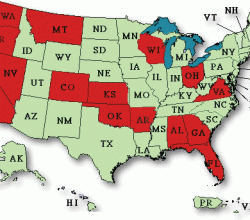
Republican lawmakers and Bible-thumping extremists are championing the Personhood Amendment in more than a dozen states across the nation. By defining that human life begins at conception, the measure essentially grants full legal rights to fertilized eggs. If passed, the Personhood Amendment would not only ban virtually all abortions, even in cases of rape and incest, but also oral contraceptives, IUDs and other methods to prevent pregnancy—a devastating blow to the 99% of women in the United States who use some form of birth control. A victory would also prohibit married women from conceiving via in vitro fertilization and outlaw embryonic stem-cell research.

The American Congress of Obstetricians and Gynecologists has declared that personhood measures “erode women’s basic rights to privacy and bodily integrity, deny women access to the full spectrum of preventive healthcare and undermine the doctor-patient relationship.” Even a resounding rejection in 2011 by Mississippi voters and a pair of defeats in Colorado haven’t been able to quell the advocates of “life begins at conception,” most notably Colorado-based Personhood USA. Here are at least 15 states where you might see the Personhood Amendment on your ballot this year: Alabama, Arkansas, California, Colorado, Florida, Georgia, Kansas, Montana, Nevada, Ohio, Oklahoma, Oregon, Virginia, Wisconsin and Washington.

Personhood Amendment


States That Have Criminalized Abortion

Wednesday, August 22nd, 2012

Here’s a list of a dozen states where abortion is virtually illegal, thus endangering women’s health and freedom.

Alabama: Although many antichoice organizations and leaders have promised that recriminalizing abortion would not result in the prosecution and imprisonment of women, the claim that human eggs, embryos and fetuses have separate legal rights has provided the basis for the arrest of about 60 women. They’ve been prosecuted under a 2006 state law that was designed to provide special penalties for people who bring children into meth labs.

Idaho: The number of abortion providers fell from seven in 2005 to four in 2011. The first arrest wasn’t a doctor but a mother of three who was charged with “unlawful abortion” for ingesting pills to induce a miscarriage because of the state’s recent ban on post-20-week abortions. The woman believed she was only 14 weeks pregnant.

Iowa: Having accidentally fallen down some stairs, a pregnant woman went to a hospital. After mentioning to a nurse that she had briefly considered abortion early in her pregnancy, the nurse called the cops, claiming the mishap was attempted selfabortion. The accident victim was arrested.

Utah: A 17-year-old—living without electricity or running water in a rural area—was impregnated by an older man who is now facing charges of using her in child pornography. The girl paid another man $150 to beat her in the stomach. It didn’t work, but she was charged with criminal solicitation for murder. (It’s worth noting that at the time, there were only seven abortion providers in the entire state.)

Louisiana: This state has a law allowing abortion clinics to be shut down for any violation of any regulation no matter how minor. Not surprisingly, there are a whole bunch of edicts that apply solely to abortion providers. So far, a clinic in New Orleans has been forced to close.

Kansas: When Dr. George Tiller was assassinated in 2009, a family physician offered to continue performing abortions at his Wichita clinic. She was barraged with threats and harassment. The U.S. Department of Justice tried to get a restraining order on one antichoice extremist who threatened to kill her, but a federal judge denied the request. Kansas now has only one licensed abortion clinic, in Highland Park.

Virginia: This state uses legal harassment to run abortion providers out of business. In addition, antichoice zealots have been trying to interfere with the U.S. Department of Health’s decision to allow abortion clinics to operate. If the antichoice advocates succeed, at least 17 of 22 clinics will have to shut their doors.

Mississippi: This state has only one abortion clinic and Governor Phil Bryant recently signed a bill that would effectively shut it down. Meanwhile, Rennie Gibbs—a 15-year-old who gave birth to a stillborn baby—is now facing the possibility of life in prison. When prosecutors learned of her cocaine habit, they charged Gibbs with the “depravedheart murder” of her child.

Indiana: A woman who was abandoned by her boyfriend had two mental breakdowns then tried to commit suicide while pregnant. She later gave birth to a baby that survived only four days. The mother was charged with murder— an attempt not only to criminalize abortion but also to set the legal groundwork for prosecuting women for murder if they terminate their pregnancies.

Arizona: The ACLU’s Reproductive Freedom Project has called this state’s antiabortion law the “most extreme bill of its kind.” That’s because it cuts the time period for a legal abortion to 18 weeks since the government considers life to begin from the last day of the woman’s menstrual cycle. Not only does it defy science, but such an early cutoff date precludes the detection of any fetal abnormalities that might suggest an abortion is advisable. The bill also specifies a mandatory ultrasound—requiring insertion of a vaginal probe!—for anyone seeking an abortion. In addition, her doctor is obligated to show the ultrasound to the pregnant woman and provide her with a photo of the unborn baby.

Ohio: Legislation that would ban voluntarily terminating any pregnancy when the fetus has a heartbeat has passed the House and is pending in the Senate, but if the bill becomes law, it could essentially criminalize all abortions in this state. In many pregnancies, there’s a detectable heartbeat before a woman notices that her period is late.

South Dakota: In 2011, Republican Governor Dennis Daugaard signed a law requiring a three-day waiting period as well as consultation with a registered antichoice pregnancy help center before a woman can have an abortion. Since there aren’t any antichoice centers willing to counsel abortion patients, the law in effect bans abortion. Planned Parenthood, which runs the only abortion clinic in the state, has been seeking an injunction to prevent the law from being enforced while its lawsuit is pending.

Meanwhile, nearly 36% of patients at Fargo, North Dakota’s only abortion clinic come from out of state, mostly South Dakota. And to avoid the hassle in Ohio, women have been traveling to clinics in Detroit. When it comes to getting a safe abortion, the name of the game is Musical States.


Aborting Freedom

Monday, August 20th, 2012

WHAT HAPPENS WHEN POLITICS ENTERS THE WOMB

by Paul Krassner

The Dinosaur Follies—better known as the 2012 Republican Presidential primaries—sucked so badly that the candidates finally turned themselves inside out. Most disgusting was the way they all pandered to their fanatical, antichoice constituents. Ironically, those same puritan politicians supposedly promoting small government also thought it was just fine to force new laws into countless unwilling vaginas.

My Campaign Pandering Award goes to Mitt Romney. He wants to overturn Roe v. Wade, the landmark 1973 Supreme Court decision that deemed abortion a woman’s fundamental right under the Constitution. And yet in 1994, when Romney was running for the U.S. Senate, he came out in favor of choice for women. Freelance journalist Suzan Mazur revealed he’d admitted to Mormon feminist Judith Dushku that “the brethren” in Salt Lake City told him he could take a pro-choice position and that, in fact, he probably had to in order to win an election in a liberal state like Massachusetts.

While Romney now believes that life begins at conception, Rick Santorum believes that life begins at foreplay. He has gone way beyond taking a fanatical stand against a woman’s right to abortion. Santorum is also against contraception even though that would prevent the need for an abortion. And he vows to “ban all pornography”—or as I call it, “masturbation helper”—despite the fact that porn would negate the need for contraception. Basically, Santorum is against pleasure itself, but he is for thought control.

When abortion was illegal in this country, women had no option but to seek out back-alley butchers to perform the procedure. If there was a botched surgery, and the patient had to be hospitalized, the police were called; they wouldn’t allow a doctor to provide a painkiller until the woman divulged the information they sought.

In 1962, a Look magazine article stated, “There is no such thing as a ‘good’ abortionist. All of them are in business strictly for money.” But in my own magazine, the Realist, I published an anonymous interview with Dr. Robert Spencer, a humane abortionist who was known as “The Saint.” Patients from around the country came to his office in Ashland, Pennsylvania. Dr. Spencer had been performing abortions for 40 years, originally charging five dollars and never charging more than a hundred. He rarely used the word pregnant. Rather, he would say,“She was that way, and she came to me for help.” He talked about “the voice of the uterus.”

Lugging my gigantic Webcor tape recorder, I took a five-hour bus trip from New York City to Ashland. It was a small town, and Dr. Spencer’s work was not merely tolerated, but the community also depended on it. The hotel, the restaurant, the dress shop all thrived on the extra business that came from his out-of-town patients.

At his clinic, Dr. Spencer built facilities for African-American patients who weren’t allowed to obtain overnight lodging elsewhere in Ashland. A sign on the ceiling over his operating table said “Keep Calm.” After my interview with Dr. Spencer was published in the Realist, I began to get phone calls from scared, desperate women. They all were in search of a safe abortionist. It was preposterous that they felt compelled to contact the editor of a satirical magazine, but they simply didn’t know where else to turn.

With Dr. Spencer’s permission, I referred them to him. At first, there were only a few calls each week, then several every day. I had never intended to become an underground abortion referral service, but I wasn’t going to stop just because the next issue of the Realist would be containing an interview with somebody else.

A few years later, Pennsylvania state police raided Dr. Spencer’s clinic and arrested him. He remained out of jail only by the grace of politi- cal pressure from those he’d helped. Dr. Spencer was finally forced to retire from his practice, but I continued mine, referring callers to other physicians he’d recommended.

From time to time, I’d be offered money by a woman seeking an abortion, but I never accepted it. And whenever a doctor offered a kickback, I refused. But I’d insist that he give a discount for the same amount to those patients referred by me.

Eventually I was subpoenaed by district attorneys in two cities to appear before grand juries investigating abortion providers. On both occasions, I refused to testify, and each time the D.A. tried to frighten me into cooperating with the threat of arrest.

In Liberty, New York, my name had been extorted from an abortion patient by threatening her with arrest. That’s why one morning at around six o’clock, there was a knock on my door. With reluctance, I was soon being driven a hundred miles to Liberty’s district attorney by the subpoena-waving man who’d awakened me. I was delivered to the D.A., who told me that the doctor had confessed everything on tape. He then gave me until two o’clock that afternoon to change my mind about testifying or else the police would come to take me away.

“I’d better call my lawyer,” I said. I went outside to a public phone and called not a lawyer but the doctor. “That never happened,” he said. I returned to the D.A.’s office and told him that my lawyer said to continue being uncooperative. Then I just sat there waiting for the cops. “They’re on their way,” the D.A. kept warning me. But at two o’clock he simply said, “Okay, you can go home now.”

Bronx District Attorney Burton Roberts took a different approach. In September 1969, he told me that his staff had found an abortionist’s financial records that showed all the money I had received. Roberts went on to say that if I cooperated with the grand jury, he’d grant me immunity from prosecution.

The D.A. extended his hand. “That’s not true,” I said, refusing to shake hands with him. If I had ever accepted any money, I’d have no way of knowing that he was bluffing. Roberts was angry, but he finally had to let me go.

On my behalf, attorney Gerald Lefcourt filed a suit challenging the constitutionality of New York State’s abortion law. Lefcourt pointed out that the district attorney had no power to investigate the violation of an unconstitutional law, and therefore he could not force me to testify. In 1970, I became the only plaintiff in the first lawsuit to declare New York State’s abortion laws unconstitutional. “Later, various women’s groups joined the suit,” Lefcourt recalls, “and ultimately the New York legislature repealed the criminal sanctions against abortion prior to the Supreme Court decision in Roe v. Wade.”

Dr. Spencer never knew about that. He had died in 1969. An obituary in the New York Times acknowledged the existence of his abortion clinic. The obituary in Ashland’s local paper did not. When I interviewed Dr. Spencer, I asked, “Do you have any idea about how many actual abortions you’ve performed during all these years?”

“To be accurate,” he replied, “it’s 27,006.” The figure, he added, included many women who had been impregnated by police and priests alike.

I never kept records of how many referrals I made, but I’d estimate at least a thousand. At one point I thought the FBI might be listening to my phone calls, and I spoke with a telephone operator to see if there was a way I could find out. She asked me why I thought my line was being tapped, and I said, “Because I refer women to doctors who perform abortions.”

It turned out that the operator was pregnant and didn’t want to be. I was glad to help her out. No wonder my religion is Coincidence.

—————————–

Paul Krassner edited his satirical magazine the Realist from 1958 to 2001. When People magazine called him “father of the underground press,” he immediately demanded a paternity test. Krassner, who was a cofounder of the Yippies (Youth International Party) and a fellow traveler of Ken Kesey and the Merry Pranksters, has authored several books. Recently, the writers’ organization PEN honored him with its Lifetime Achievement Award. Krassner also publishes the infamous Disneyland Memorial Orgy poster available at PaulKrassner.com.


Is Ben Quayle a Pornographer?

Friday, August 17th, 2012

According to Politico, Ben Quayle — the son of George H. W. Bush’s former Vice President Dan Quayle — has a connection to the adult themed website TheDirty.com. Why is this relevant? It seems that Ben is running for the U.S. Congress in the Arizona primary, waving the tried and true “Family Values” banner. However, back in 2007, when the site was called DirtyScottsdale.com, it’s believed that Quayle wrote a column for them under the name of Brock Landers. At first Quayle, the younger, denied the claim. More recently he has begun to back peddle. If the accusation is true, then Ben Quayle is even dumber than his dad. True or not, we don’t want to see another Quayle holding political office.

FOR THE FULL STORY: http://www.verumserum.com/?p=16483


Wily Banker

Monday, August 13th, 2012

TAXPAYERS END UP FOOTING THE BILL AFTER CITIGROUP’S HEAD HONCHO SELLS A PREZ ON DEREGULATING THE FINANCIAL INDUSTRY

by Robert Scheer

Some guys have all the luck, particularly when they supply the dice. Take Sanford “Sandy” Weill, the banker who did more than any of his fellow scoundrels to precipitate this country’s financial crisis, but who managed to bail out, richer than ever, before the crash.

Earlier this year, Weill made another killing by selling his Manhattan penthouse, which he reportedly purchased for $43.7 million in 2007. The listed selling price for the digs was a cool $88 million, far exceeding any residential transaction in America’s priciest real estate market. But don’t worry about Sandy not having a place to stay; after all, he still has that $35-million estate in the wine region of California and other illgotten gains.

This is the banker who hustled and bought a Republican- led Congress and Democratic President Bill Clinton back in the 1990s and in return was gifted with the reversal of Depression- era rules preventing the emergence of too-bigto- fail banks. The biggest one of all was Citigroup, which Weill created and would ultimately become the world’s largest financial conglomerate.

Weill formed what the New York Times termed a “monster bank” based on a Federal Reserve temporary exemption from existing banking law. But to remain a permanent entity, his then-fledgling bank needed the law itself changed. The obstacle to Weill’s greedy ambitions back then was the Glass-Steagall Act, which long had been a barrier between investment and commercial banks. The 1999 reversal of Glass- Steagall that Weill engineered permitted the merger of Travelers Group—a private investment firm that Weill headed—with Citibank, a commercial bank holding the federally insured savings of ordinary folk.

The Republicans had been on a tear to obliterate the sensible rules governing the financial industry ever since Democratic President Franklin Roosevelt put them into place in response to the Great Depression. FDR did so to prevent another economic calamity. For five decades, Democrats resisted the Wall Street lobbyists and their Republican lapdogs. That is, until Sandy Weill got his buddy Clinton to sign off on the Republican-sponsored legislation that upended the sensible restraints on finance capital which had worked splendidly— for consumers, if not bankers—for half a century.

The night before the announcement of the merger, as Wall Street Journal reporter Monica Langley writes in her book Tearing Down the Walls: How Sandy Weill Fought His Way to the Top of the Financial World…and Then Nearly Lost It All, a buoyant Weill suggested to John Reed, his partner in the merger, “We should call Clinton.” Having no trouble getting through to the President on a Sunday night, Weill informed him of the merger, which violated existing law. After hanging up, Weill boasted to Reed, “We just made the President of the United States an insider.”

That Hillary Clinton was gearing up for a Senate race in New York, the capital of high finance, helped make Weill’s case with the President. Also pushing the Wall Street lobbyists’ cause was Robert Rubin, Clinton’s Treasury Secretary, who had been a honcho at Goldman Sachs prior to taking the Cabinet post. The ink was barely dry on the legislation legitimizing the creation of Citigroup when Rubin went to work at Weill’s bank for $15 million a year. That lucrative career move personifies what I call the revolving platinum door between Washington, D.C., and Wall Street, and Weill was a master at spinning it.

At the signing ceremony, where Clinton presented Weill with one of the pens that fine-tuned Glass-Steagall out of existence, the President proclaimed, “Today what we are doing is modernizing the financial services industry, tearing down those antiquated laws and granting banks significant new authority.”

That “modernization” led to a housing bubble that, when punctured by reality, left 50 million Americans with their homes foreclosed or struggling to keep up with underwater mortgages. As of this writing, 46 million Americans have been reduced to poverty, and tens of millions more are part of an unemployed and underemployed labor force that may never recover.

Neither Republican George W. Bush nor Democrat Barack Obama acted to aid those beleaguered victims of Weill’s folly. But thanks to the bailout policy, the banker himself made out like a bandit. Citigroup would have gone under except for the infusion of $45 billion in direct federal aid and the government’s underwriting of $300 billion of the bank’s toxic paper. We ordinary taxpayers are left holding that debt while Sandy Weill gets to toast with the finest bubbly at his winecountry estate.

———————————

Before serving almost 30 years as a Los Angeles Times columnist and editor, Robert Scheer spent the late 1960s as Vietnam correspondent, managing editor and editor in chief of Ramparts magazine. Now editor of TruthDig.com, Scheer has written such hard-hitting books as The Pornography of Power: How Defense Hawks Hijacked 9/11 and Weakened America and his latest, The Great American Stick-Up: Greedy Bankers and the Politicians Who Love Them.


Why Isn’t Pot Legal?

Monday, August 6th, 2012

With polls showing that 50% of Americans favor the legalization of marijuana, why aren’t steps being taken to make that a reality? Blame those that have the most to lose from legal weed: the pharmaceutical, alcohol and prison industries. Pharmaceutical companies don’t want people turning to pot for pain relief because it would mean fewer customers buying prescription medications. Brewers and distillers don’t want the competition either. With mounting scientific evidence that pot is safer than alcohol, legal marijuana would clearly put a major dent in the booze business’s profits. Private, for-profit prisons only make money if they’re filled to capacity, and that means locking up weed growers and pot smokers.

Larry Flynt


larry flynt's book