Larry Flynt

Posts Tagged ‘treason’

High Treason

Monday, January 16th, 2012

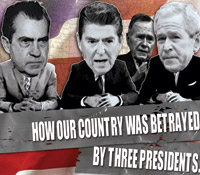
HOW OUR COUNTRY WAS BETRAYED BY THREE PRESIDENTS

by Bob Fitrakis and Harvey Wasserman for HUSTLER Magazine

Presidential TreasonThe not-so-slow death of our nation by betrayal, bankruptcy and despair has not happened by accident. Three treasonous backstabs by Republicans Richard Nixon, Ronald Reagan (in cahoots with George H.W. Bush) and George W. Bush have poisoned our body politic and bled us into chaos. The first act of treason came in 1968 as the Vietnam War reached a critical turning point. Democratic President Lyndon Baines Johnson was desperate for a truce between North and South Vietnam. His Vice President, Hubert Humphrey, was in a tight Presidential race against Richard Nixon. With demonstrators in the streets, Humphrey needed a cease-fire to get himself into the White House.

Johnson had it all but wrapped up. With a combination of gentle and iron-fisted persuasion, he forced the leaders of South Vietnam into an all-but-final agreement with the North. A truce was imminent, and Humphrey’s election seemed assured. But at the last minute the South Vietnamese pulled out.

In his 1983 book The Price of Power, Seymour Hersh revealed that Henry Kissinger—then LBJ’s adviser on Vietnam peace talks—secretly alerted Nixon’s staff that a cease-fire was looming. According to Hersh, Nixon “was able to get a series of messages to the [President Nguyen Van] Thieu government, making it clear that a Nixon presidency would have different [more favorable] views on the peace negotiations,” hence South Vietnam’s abrupt withdrawal from the Paris peace talks.

Johnson was livid. He even called the Republican Senate Minority Leader, Everett Dirksen, to complain that “they oughtn’t be doing this. This is treason.” “I know,” Dirksen feebly replied.

Johnson blasted Nixon about this on November 3, 1968, just prior to Election Day. As Robert Parry of ConsortiumNews.com has written, “When Johnson confronted Nixon with evidence of the peace-talk sabotage, Nixon insisted on his innocence but acknowledged that he knew what was at stake.”

Said Nixon: “I would never do anything to encourage…Saigon not to come to the table. … Good God, we’ve got to get them to Paris or you can’t have peace.”

With the war still raging, Nixon claimed a narrow victory over Humphrey. He then named Kissinger as his National Security Advisor.

During Nixon’s first term, more than 20,000 U.S. troops died in Vietnam. More than 100,000 were wounded. More than a million Vietnamese were killed. But in 1973, Kissinger was awarded the Nobel Peace Prize for negotiating the same settlement in 1972 he’d helped sabotage four years earlier.

According to Parry, Johnson wanted to go public in 1968 with Nixon’s treason. But Clark Clifford, an architect of the CIA and a pillar of the Washington establishment, dissuaded him. In particular, Clifford told LBJ (in a taped conversation) that “some elements of the story are so shocking in their nature that I’m wondering whether it would be good for the country to disclose the story and then possibly have a certain individual [Nixon] elected. It could cast his whole administration under such doubt that I think it would be inimical to our country’s interests.”

In other words, Clifford told LBJ that the country couldn’t handle the reality that its President was a certifiable traitor eligible for the death penalty. Fittingly, Clifford’s upper-crust career ended in disgrace thanks to his entanglement with the crooked Bank of Credit and Commerce, which financed the terrorist group al-Qaeda.

Tormented by the disastrous war that destroyed his Presidency, Johnson died just four years after leaving the White House. Nixon was reelected in 1972, again with a host of dirty dealings, then became the first U.S. President to resign in disgrace. But along the way, Nixon trained a new generation of dirty tricksters that included Dick Cheney, Donald Rumsfeld, Karl Rove, William Casey and George H.W. Bush.

It was this Bush who engineered a second act of treason that put Ronald Reagan into the Oval Office with him as Vice President. What became known as “the October surprise” began in 1979 when Iranian revolutionaries seized the U.S. Embassy in Tehran and took 52 American hostages, holding them deep into this country’s 1980 Presidential campaign. As Election Day neared, incumbent President Jimmy Carter announced he had a deal to bring them home.

Suddenly, however, the deal evaporated. The 52 Americans remained in Iran, and Reagan overcame unfavorable preelection polls to win a landslide victory. “Coincidentally” the hostages were released on January 20, 1981, as Reagan was being sworn in.

Very quickly a wide range of credible sources claimed the GOP had pulled off another game-changing act of treason. Gary Sick, a member of the National Security Council under Presidents Ford and Carter, wrote in the New York Times that the Reagan campaign had illegally interfered with Carter’s negotiations to bring the hostages home.

Sick’s devastating allegations were confirmed by Abholhassan Bani-Sadr, who was elected president of Iran during the hostage crisis. In his book My Turn to Speak: Iran, the Revolution and Secret Deals With the U.S., Bani-Sadr said ex-CIA Director George H.W. Bush and future CIA Director William Casey conspired with Iranian leaders to sabotage President Carter’s attempts to free the hostages.

According to what Bani-Sadr told author Barbara Honegger— a former Reagan-Bush campaign staffer and GOP White House a n a l y s t — t h e Iranians “made a deal with Reagan that the hostages should not be released until after Reagan became President. So then, in return, Reagan would give them arms. We have published documents which show that U.S. arms were shipped, via Israel, in March [1981], about two months after Reagan became President.”

Sergei V. Stepashin, a high-ranking Russian official, made the same claims and—according to reporter Robert Parry—released corroborating files to the U.S. Congress documenting the treason. (It was Parry who broke the Iran-Contra story for Newsweek and the AP.)

Arms dealer and CIA contract employee Richard Brenneke testified that he had flown Reagan’s campaign director, William Casey, to Paris for a series of secret meetings with the Iranians while Carter was also negotiating with them. Brenneke said Casey did the deal to keep the hostages captive until Reagan was sworn in.

Brenneke’s assertions were tested in court when he was found not guilty after being charged with perjury. Jury foreman Mark Kristoff said in an interview, “We were convinced that, yes, there was a meeting, and he [Brenneke] was there, and the other people listed in the indictment were there. … There never was a guilty vote. … It was 100%.”

Ari Ben-Menashe, purportedly an Israeli intelligence agent, swore under oath before Congress that he saw Bush in Paris over the weekend of October 18-19, 1980. Ben- Menashe told Congress that Bush and Casey were in a hotel and headed into negotiations with radical Iranian cleric Mehdi Karroubi. Parry points out in his book Trick or Treason that the late Yasser Arafat—head of the Palestine Liberation Organization—disclosed to President Carter that Republicans seeking help in arranging the logistics of the October surprise arms-for-hostages deal had contacted the PLO in 1980. Alexandre de Marenches, former chief of French intelligence, confided to his biographer that the French secret service had aided Casey in meeting with the Iranians in Paris in 1980.

It is legally treasonous for private citizens to interfere with official negotiations between the U.S. government and a foreign power. Thus, Reagan’s sabotage of Carter’s attempts to bring the embassy hostages home from Tehran—like Nixon’s sabotage of LBJ’s Vietnam peace talks—clearly qualifies as a capital crime.

George W. Bush threw his hat in the ring of “aiding and abetting the enemy” by illegally outing a covert CIA agent in 2003. The felony came as part of the cover-up of the lies he’d employed to suck America into an illegal war.

In the wake of the terror attacks of September 11, 2001, Bush declared he would bring al-Qaeda leader Osama bin Laden to justice. Not long after that, however, Bush all but abandoned the search for Bin Laden. Instead, he told the American public, war was needed to rid Iraq’s U.S.-sponsored dictator, Saddam Hussein, of “weapons of mass destruction.”

Hussein had nothing to do with the 9/11 attacks. In fact, he was Bin Laden’s sworn enemy. Former Secretary of Defense Donald Rumsfeld has since confirmed that Bush knew full well Hussein had no such WMDs. In his recent autobiography, Rumsfeld reveals that Bush’s real reason for going after the Iraqi dictator was to settle a deep psychological score with his father, George H.W. Bush.

Among other things, the younger Bush ordered Secretary of State Colin Powell to lay out before the United Nations a series of blatant falsehoods meant to win support for a U.S. invasion of Iraq. The key lie was a fabricated scenario in which Hussein supposedly tried to obtain uranium for nuclear weapons from an African country. As Bush put it in his infamous 2003 State of the Union address: “The British government has learned that Saddam Hussein recently sought significant quantities of uranium from Africa.”

That White House lie led to a horrific war that has cost the lives of thousands of Americans and hundreds of thousands of Iraqis—not to mention a trillion or more U.S. dollars. The lie was accompanied by an impeachable felony—a blatantly illegal betrayal of a CIA agent.

On July 6, 2003—almost six months after Bush’s deceitful State of the Union address— former ambassador Joseph C. Wilson IV wrote a New York Times op-ed refuting Bush’s cover story for the Iraq War. In “What I Didn’t Find in Africa,” Wilson—who had been sent to Niger by the CIA to investigate the supposed British claims—said he had “little choice but to conclude that some of the intelligence related to Iraq’s nuclear weapons program was twisted to exaggerate the Iraqi threat.”

Wilson contradicted Bush’s claim that Hussein had obtained yellowcake uranium from Niger to build a radioactive weapon. As Wilson put it, “Selling uranium would require the approval of the minister of mines, the prime minister and probably the president. In short, there’s simply too much oversight over too small an industry for a sale to have transpired.” To cover the lie he had told to get the United States into war, Bush decided to discredit and destabilize Wilson—by putting the life of the diplomat’s wife, covert CIA officer Valerie Plame, in jeopardy. But as stipulated by the Intelligence Identities Protection Act of 1982 (passed while Bush’s father was Vice President), it is a felony to identify an undercover CIA agent.

The law reads in part that “whoever, having or having had authorized access to classified information that identifies a covert agent, intentionally discloses any information identifying such covert agent to any individual not authorized to receive classified information, knowing that the information disclosed so identifies such covert agent…shall be…imprisoned not more than ten years.” George H.W. Bush himself stated that any American revealing such info would be committing treason.

After Wilson’s op-ed appeared, senior White House adviser Karl Rove indirectly confirmed for syndicated Washington Post columnist Robert Novak that Plame was a CIA agent. On July 11, Rove did the same for Time magazine’s Matthew Cooper, according to the reporter’s subsequent grand jury testimony. Cooper had previously confirmed hearing about Plame from Vice President Dick Cheney’s chief of staff, I. Lewis “Scooter” Libby, but that Libby hadn’t mentioned her by name.

In his July 14, 2003, column titled “Mission to Niger,” Novak denounced Ambassador Wilson’s claim that the Bush Administration was manipulating data to sell an unjust war. Novak wrote: “Wilson never worked for the CIA, but his wife, Valerie Plame, is an Agency operative on weapons of mass destruction.”

Meanwhile, White House Press Secretary Scott McClellan denied that Rove was Novak’s anonymous source. Following an FBI investigation and a grand jury hearing, Libby was convicted of obstruction of justice, making false statements and two counts of perjury. Neither Libby nor Rove was ever indicted for disclosing Plame’s status as a covert CIA agent to Novak. Cheney later publicly excoriated Bush for not protecting Libby. And in 2008 McClellan toured the nation with his tell-all book What Happened , charging that Bush had authorized the unmasking of Plame’s identity. McClellan told CNN that Cheney should be forced to testify under oath about the Plame leak.

In his book Daybreak, David Swanson writes that Special Counsel Patrick Fitzgerald, who prosecuted Libby, had direct evidence—including a handwritten note by Cheney—that both the President and Vice President were involved in the Plame scandal. According to Swanson, Bush’s commutation of Libby’s sentence “directly interfered with the Special Counsel’s ongoing investigation of Plame’s ‘outing’ and therefore constituted obstruction of justice.”

In all, George W. Bush lied to America and the world about weapons of mass destruction he knew were nonexistent. He then feloniously outed a CIA agent, putting her life and the lives of other intelligence agents at risk, an impeachable crime. Next, he abused his Presidential power by covering it all up, another impeachable offense.

Does this constitute treason? If it doesn’t, what does?

Despite knowing about Richard M. Nixon’s 1968 act of treason, Lyndon B. Johnson chose to remain silent. Although the realities of 1980’s October surprise have been widely published, Jimmy Carter has said nothing, and Bill Clinton took no action while he was President. Now Barack Obama has refused to prosecute George W. Bush and his henchmen Cheney and Rove for Plamegate and their treasonous crimes in Iraq. Through it all the United States has been transformed from the world’s most prosperous country to the most debt-ridden. From a nation built on hopeful democratic ideals to one dominated by large corporations that care about nothing but power and profit.

What it will take to reverse the damage remains to be seen—if indeed it’s even possible. But a good start would be to charge those who committed the acts of treason that made this nightmare happen.

——————————–
Ohio-based investigative reporters Bob Fitrakis and Harvey Wasserman, who write columns for FreePress.org, have coauthored a number of books on the George W. Bush era and election theft. For more, visit Fitrakis.org and HarveyWasserman.com.


SIBEL EDMONDS: THE TRAITORS AMONG US

Thursday, February 18th, 2010

SIBEL EDMONDS HAS NAMED NAMES. WHY ISN’T THE MEDIA REPORTING THE STORY?

by Brad Friedman
for HUSTLER MAGAZINE – March 2010

SIBEL EDMONDS, a former FBI translator, claims that the following government officials have committed what amount to acts of treason. They are lawmakers Dennis Hastert, Bob Livingston, Dan Burton, Roy Blunt, Stephen Solarz and Tom Lantos, as well as at least three members of George W. Bush’s inner circle: Douglas Feith, Paul Wolfowitz and Marc Grossman. But is Sibel Edmonds credible?

“Absolutely, she’s credible,” Senator Chuck Grassley (R-Iowa) told CBS’s 60 Minutes when he was asked about her in 2002. “The reason I feel she’s very credible is because people within the FBI have corroborated a lot of her story.” Edmonds’s remarkable allegations of bribery, blackmail, infiltration of the U.S. government and the theft of nuclear secrets by foreign allies and enemies alike rocked the Bush Administration. In fact, Bush and company actually prevented Edmonds from telling the American people what she knew—up until now.

John M. Cole, an 18-year veteran of the FBI’s Counterintelligence and Counterespionage departments, revealed the panic of upper-echelon officials when Edmonds originally started talking back in 2002. “Well, the Bureau is gonna have to try to work something out with Sibel,” Cole said an FBI executive assistant told him at the time, “because they don’t want this to go out and become public.”

But they couldn’t “work something out with Sibel” because, it seems, she wasn’t looking to make a deal. Edmonds says she was looking to expose what she believed to be the ugly truth about the infiltration of the U.S. government by foreign spies. They were enabled, Edmonds claimed, by high-ranking U.S. officials and insider moles planted at nuclear weapons facilities around the nation.

“Everybody at headquarters level at the Bureau knew what she was saying was extremely accurate,” Cole said recently. “They were trying to figure out ways of keeping this whole thing quiet because they didn’t want Sibel to come out.”

Her under-oath testimony for the Ohio Election Commission, given in a recent videotaped deposition, is both shocking and horrifying. (Edmonds was the star witness for Congressional candidate David Krikorian in connection with a formal complaint initiated by Representative Jean Schmidt [R-Ohio]. Challenging her in 2008, a Krikorian flyer had accused Schmidt of accepting “blood money” from Turkish interests to help block a House bill recognizing Turkey’s genocide of Armenians in 1915.) The deposition was allowed to proceed by the Obama Administration, which chose not to invoke the draconian and little-known “State Secrets Privilege” to gag her, as the previous administration had done, twice.

Edmonds testified that Congressman Dennis Hastert (R-Illinois), a former Speaker of the House, was involved in “several categories” of corruption on behalf of Turkish agents, according to information she claims to have heard while translating and analyzing FBI counterintelligence wiretaps recorded from 1996 through 2002. She mentioned his “acceptance of large sums of bribery in forms of cash or laundered cash” coupled with the ability “to do certain favors…make certain things happen for… [the] Turkish government’s interest.”

Edmonds also alleged, on the public record, Hastert’s use of a “townhouse that was not his residence for certain not very morally accepted activities” and said that “foreign entities knew about this. In fact, they sometimes participated in some of those…activities in that particular townhouse.”

The allegations against Hastert include accepting some half-million dollars in bribes. While several FBI sources have corroborated Edmonds’s account, the best Hastert’s attorneys could do was offer a nondenial denial to the charges. But the proof, as they say, may be in the post-Congressional pudding. As Edmonds had predicted years earlier, Hastert—who left Congress in 2007—now makes $35,000 a month lobbying his old colleagues as a registered foreign agent for the Turkish government.

Former Congressman Bob Livingston (RLouisiana), who was set to become Speaker prior to Hastert until evidence of a sexual affair was revealed by Larry Flynt, was described in Edmonds’s deposition as having participated in “not very legal activities on behalf of foreign interests” before leaving office in 1999. Afterward, she said, Livingston acted “as a conduit to…further foreign interests, both overtly and covertly,” and also became both a lobbyist and “an operative” representing Turkish interests.

According to Edmonds, Representative Roy Blunt (R-Missouri)—likely to run for a U.S. Senate seat in 2010—was “the recipient of both legally and illegally raised…campaign donations from…Turkish entities.” Edmonds also claimed that hard-right Representative Dan Burton (R-Indiana), who was instrumental in the impeachment of President Bill Clinton, carried out “extremely illegal activities” and covert operations that were “against the United States citizens” and “against the United States’ interests.”

Edmonds named allegedly traitorous Democrats too. She said that former New York Congressman Stephen Solarz, now also a lobbyist, “acted as conduit to deliver or launder contributions and other bribe[s, including blackmail] to certain members of Congress.” And, according to Edmonds, the late Congressman Tom Lantos (D-California) was said to have been involved in “not only…bribe[ry], but also…disclosing [the] highest level protected U.S. intelligence and weapons technology information both to Israel and to Turkey [and] other very serious criminal conduct.”

The most overtly salacious of the allegations involved Representative Jan Schakowsky (D-Illinois), who is “married with…grown children, but she is bisexual,” according to Edmonds. The FBI whistleblower described how Schakowsky was “hooked” by Turkish agents into having a lesbian “sexual relationship with one of their spies,” and “the entire episodes of their sexual conduct was being filmed because the entire house…was bugged…to be used for certain things that they wanted to request.”

Edmonds noted, however, that she didn’t “know if she [Schakowsky] did anything illegal afterwards” since Edmonds was fired by the FBI before learning what came of that particular setup. The Turks, she said, intended to get at Schakowsky’s husband, lobbyist Robert Creamer, who in April 2006 began serving five months in prison (and 11 months of house arrest) for check-kiting and failing to collect withholding tax.

Schakowsky’s office has vehemently denied the allegations. As head of the U.S. House Intelligence Committee’s Subcommittee on Oversight and Investigation, Schakowsky might be expected to hold hearings on any of the former FBI employee’s revelations but she has not. She has also refused Edmonds’s challenge to take a polygraph test and has not yet sued her for libel, as the whistleblower has challenged her to do.

Edmonds’s most disturbing allegations, however, may be against high-ranking appointed officials in the Bush Administration. Elaborating on testimony she laid out in her sworn deposition, Edmonds told American Conservative magazine’s Phil Giraldi—a 17-year CIA counterterrorism officer—very specific details of alleged traitorous schemes perpetrated by top State and Defense Department officials. As already noted, these included Douglas Feith, Paul Wolfowitz and, perhaps most notably, former Deputy Undersecretary of State Marc Grossman, the third-highest-ranking official in the Bush State Department.

Edmonds said that Feith and Wolfowitz were involved in plans to break Iraq into U.S. and British protectorates months prior to 9/11. She also claimed that the duo shared information with Grossman on how to blackmail various officials and that Grossman had accepted cash to help procure and sell nuclear weapons technology to Israel and Turkey—and, from there, on to the foreign black market. There the technology would be purchased by the highest bidder, such as Pakistan, Iran, Libya, North Korea or possibly even al-Qaeda.

Additionally, Edmonds claimed that Grossman, the U.S. Ambassador to Turkey before taking his State Department post, had tipped off Turkish diplomats to the true identity of covert CIA operative Valerie Plame Wilson’s front company, Brewster Jennings & Associates, a full three years prior to their being publicly outed by columnist Robert Novak. That in itself, according to George H.W. Bush, would be an act of treason carried out by “the most insidious of traitors.”

Former CIA counterterrorism officer Giraldi summed up Edmonds’s disclosures to me in blunt terms: “This was a massive coordinated espionage effort directed against United States nuclear secrets engineered by foreign agents who successfully corrupted senior government officials and legislators in our Congress. It’s that simple.”

According to a declassified version of a 2005 Department of Justice Inspector General’s report, Sibel Edmonds’s allegations are “credible,” “serious” and “warrant a thorough and careful review by the FBI.”
Perhaps more damningly, the FBI’s John Cole recently confirmed a key element of Edmonds’s claims when he revealed the existence of “the FBI’s decade-long investigation” of the State Department’s Grossman. Edmonds claimed that Grossman was perhaps the top U.S. ringleader for the entire foreign espionage scheme. The probe, Cole added, “ultimately was buried and covered up.”

Cole, who now works as an intelligence contractor for the Air Force, not only finds Edmonds “very credible,” but also confirms the “ongoing and detailed effort by Turkey to develop influence in the United States” through a number of illegal means.

“Turkish individuals would ask for favors—ya know, ‘You help me out, and I’ll help you out’—and basically what would happen is the elected official would either receive money or some kind of gift,” Cole explained. “Or, if it was a government employee, I’ve seen it where after they retired, they get these very lucrative positions with a Turkish company, or whatever the country may be.”

As noted, Hastert now works for Turkey, and Grossman now works for a Turkish company and as a lobbyist—no doubt raking in a pretty penny from both. Hastert and Grossman repeatedly ignored requests to comment on these charges.

The mainstream U.S. media, however, apparently remain uninterested in investigating any of it. Not even after Cole himself called for a “Special Counsel” to investigate and prosecute. So what the hell is going on here?
Giraldi believes that, as with companies such as AIG and GM becoming “too big to fail,” the size and success of this massive national security espionage scandal has simply become too big to bust.

He told me, “You have to look at Marc Grossman being part of a much bigger operation in terms of the Israelis and the Turks obtaining influence over our legislators and over a number of senior government officials at the Pentagon and State Department. Because this thing was so big, and it affected both Democrats and Republicans, I think the U.S. government is terrified of opening up this Pandora’s box.”

Giraldi added, “The people in Congress and in the Justice Department who should be investigating this…and also in the media—because the media is tied hand and foot to government—this is all part of one big, you know, conspiracy, if you want to look at it this way. And, essentially, this is a story that they don’t want to get out.”

So why, exactly, isn’t the media covering Sibel Edmonds, whom the ACLU once described as “the most gagged person in the history of the U.S.,” now that she is finally able to tell her story? It’s a story, after all, that the legendary 1970s whistleblower Daniel Ellsberg has deemed “far more explosive than the Pentagon Papers.”

“If we had an effective mainstream media that was going after this story, that would make it come out,” Giraldi noted. “But we don’t have an effective media.” He then pointed out one more reason for the media’s reluctance to dig into this story: “According to Sibel, Grossman actually bragged that he would get from the Turks the information that they wanted to appear in an article. He would write it up, and he would fax it over to the New York Times, and they would print it just as he had written it under somebody else’s byline.”

Guess we won’t expect any coverage of this scandal from the New York Times, “the paper of record,” any time soon. And if a story isn’t covered by the Times, and thereafter picked up by everybody else, did it really happen? Given the complicity of the media with regard to Sibel Edmonds, it would appear the government never even needed to invoke the “State Secrets Privilege” in the first place.

As of this writing, HUSTLER stands to be the largest, most “corporate” U.S. outlet in which these startling, now-public, on-the-record disclosures have been reported. The moral: Pull off a large enough crime, and it becomes too big to do anything about.

——————————————

HUSTLER Magazine March 2010
You may purchase the hard copy of the March 2010 Issue of HUSTLER Magazine (with free shipping) at HustlerMagazine.com. Comes with full length DVD and free shipping!

You may purchase a digital copy of the March 2010 Issue of HUSTLER Magazine at UnderCoverMags.com.


larry flynt's book